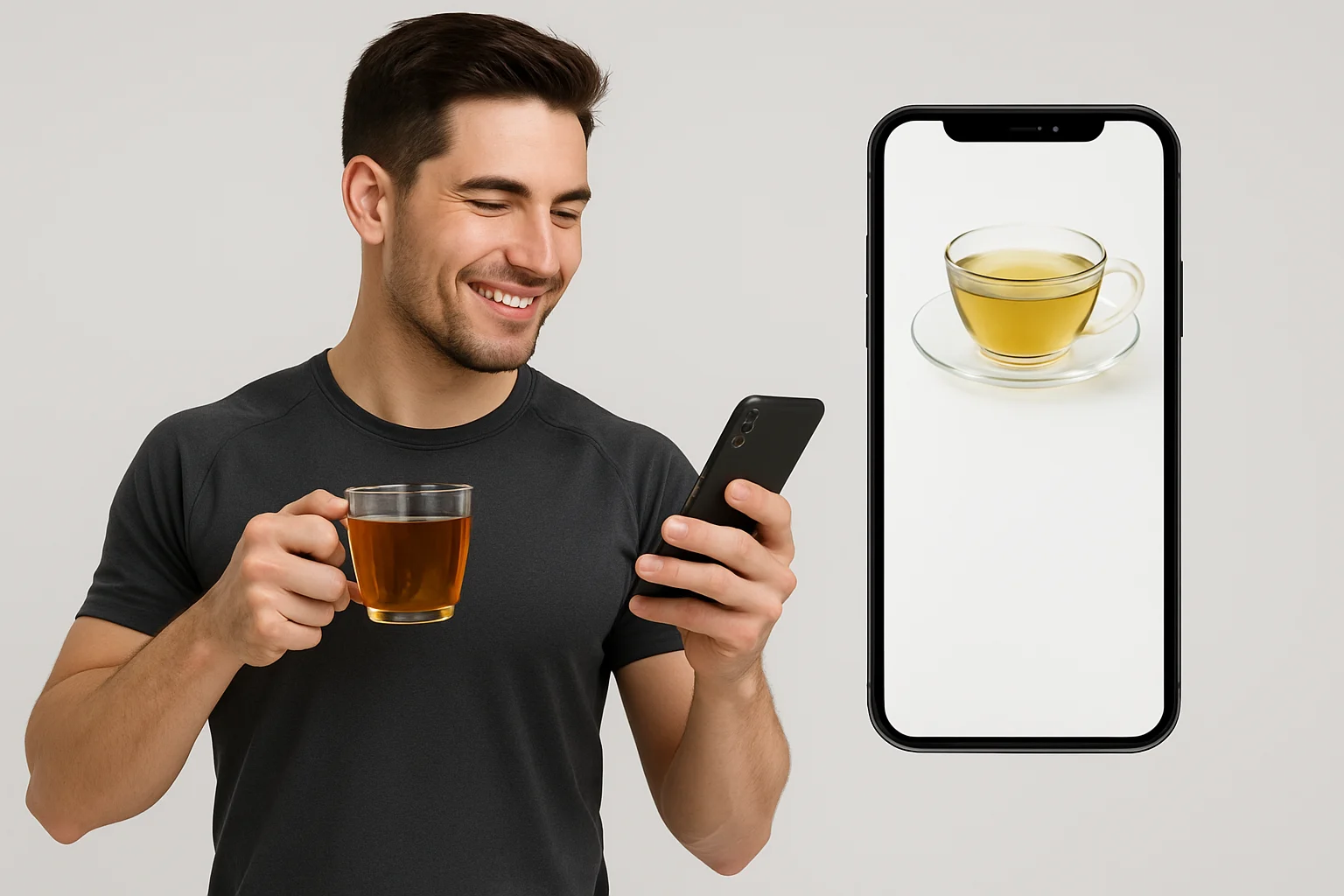
Tea Timer on Your Phone: Steeping Time Without Bitterness
 Put Rodrigo Oliveira
Bitter tea is almost never the fault of the tea leaves: it's either over-infusion or the water is too hot. That's why there's an entire category of apps dedicated to a seemingly silly function—timing your cup of tea. For those with busy schedules who prepare tea between appointments, the timer solves the most common problem with the beverage.
This guide is about that: how long and at what temperature each type of tea should be brewed, why overcooking ruins the flavor, and which apps do the job well. No promises of energy, performance, or treatment—tea is a beverage, and what a timer delivers is a better cup.
Why time changes everything.
The leaf releases compounds in order. First, the aromatics and amino acids are released, responsible for the more delicate flavor and sweet sensation. Then come the tannins, which provide astringency—that dry mouth sensation—and, in excess, bitterness. Leaving the leaf in water longer than recommended means extracting mainly the second part.
Temperature plays a similar role. Boiling water over green tea extracts tannins too quickly and burns the delicate notes of the leaf. Conversely, black tea prepared with lukewarm water becomes watery because there hasn't been sufficient extraction.
Time and temperature by type of tea
Green Tea
Between 70 and 80 degrees Celsius, with a steeping time of 1 to 3 minutes. This is the most sensitive of all: even one minute more can change the result in the cup.
White tea
From 75 to 85 degrees, for 2 to 5 minutes. Mild flavor, which is lost with very hot water.
Oolong
From 85 to 95 degrees Celsius, for 2 to 4 minutes. It accepts several infusions from the same leaf, each revealing a different profile.
Black tea
Between 95 and 100 degrees Celsius, for 3 to 5 minutes. This is the most tolerable and most common temperature used daily.
Pu-erh
Use very hot water, with a quick rinse before the first infusion and then for 1 to 3 minutes per round.
Herbal infusions
Chamomile, mint, fennel, and lemongrass require boiling water and steeping for 5 to 10 minutes, always with the container covered to preserve the aromatic oils. They do not contain caffeine.
Apps that do this job
Tea Time – Kitchen Timer
From developer Andreas Miklautsch, with a note 4.8 (372 reviews) Available on the Play Store. It offers preset times for each type of tea, manual adjustment, and an alarm. It's the highest-rated among simple timers and doesn't require registration.
Tea Timer
Published by developer Diwebsity, it has a minimalist approach: choose your tea, touch it, and wait. The store listing doesn't have a consolidated published rating, so it's worth checking the recent reviews.
Tea Cup – Timer
From developer Cobalt Sign, also without a published review in the store. Streamlined interface, with countdown and notification.
MyTeaPal
It goes beyond a stopwatch and functions as a tea diary, recording the type of leaves, temperature, and evaluation of each preparation. It appears in the store with a rating. 5.0 (577 reviews). It's the choice of those who want a history, not just an alarm.
What happens chemically during infusion?
Understanding the process explains why time and temperature matter so much — and why "leaving it longer" doesn't make it stronger.
Water extracts compounds from the leaf at different rates:
- First, the aromatic compounds and caffeine are eliminated., ...more soluble. That's why the first infusion is the most fragrant and stimulating.
- Next come the tannins., responsible for astringency and bitterness. They are released more slowly — and it is their extraction that a long infusion favors.
- Temperature speeds everything up. Boiling water in green tea extracts tannins too quickly, resulting in a bitter cup before it's flavorful.
Hence the practical rule that contradicts intuition: For a richer tea, use more leaves — not more steeping time. Increasing the cooking time increases astringency, not the intensity of the flavor.
Multiple infusions: making use of the same leaf
It's a common practice in various traditions, but little known here. A whole leaf of good quality yields more than one infusion, and each has its own profile:
- The first It is aromatic and more stimulating because it contains the majority of the caffeine.
- The second It tends to be the most balanced in flavor.
- The third one onwards It becomes milder and has less caffeine — useful for those who want to do the ritual at night.
Two conditions for it to work: full sheet, Because sachets with broken sheets release almost everything at once; and don't leave the wet leaf waiting There are several hours between infusions. The second infusion usually takes a little longer than the first.
Water, utensils and preservation
- Filtered water makes a noticeable difference. Chlorine and excess minerals alter the taste more than most people realize.
- Do not reboil the same water. repeatedly — it loses dissolved oxygen and the tea gets "high".
- Space for the page to open. A very small infuser hinders expansion and reduces extraction; a wide strainer or teapot with more space yields better results.
- Store the sheet in an opaque, airtight container., Keep away from heat, humidity, and strong-smelling spices — the leaf absorbs odor easily.
- Tea doesn't spoil, but it does age. It loses its aroma over the months, and the green variety loses it faster than the black one.
- Do not refrigerate. In an open container: moisture condenses when removed and then re-enters the container.
And the adjustment that fixes most bad cupping problems without any app: Water below boiling point for green and white tea., ...and the timer is on — because the difference between the right time and the bitter taste is less than a minute, and that's exactly what gets forgotten while doing something else.
Questions that arise later
Can I use the timer on my phone?
Yes, it does work. The advantage of a dedicated app is that it saves the time and temperature for each type of tea, and allows you to save your preferred setting—which avoids having to relearn it for every cup.
Can tea that has cooled down be reheated?
It's possible, but the aroma is lost; reheating in the microwave usually accentuates the astringency. It's better to make a smaller quantity and drink it immediately, or prepare it cold on purpose, with a long infusion in ice water — a method that extracts much less tannin.
Sachet or whole sheet?
Tea bags are convenient and use broken leaves, which release almost all the infusion at once and become bitter faster. Whole leaves yield more infusions and offer more control. If using tea bags, reduce the steeping time.
Does sweetening change the steeping time?
No, but it masks the bitterness — which is why many people end up with excessive infusion without realizing it. It's worth trying it without sugar for a few days to adjust the time, and then sweeten it if you want.
Does caffeinated tea at night disrupt sleep?
It tends to be disruptive, and the effect lasts for hours. If you don't want to give up the ritual, herbal infusions generally don't contain caffeine, and the third infusion of the same leaf has much less than the first.
Frequently Asked Questions
The stopwatch on your phone will do the trick. The advantage of a dedicated app is that it already has the times and temperatures for each type of leaf, without needing to look anything up.
A practical guideline: after boiling, water loses heat quickly. Waiting about a minute in an open container usually brings it to the oolong range, and two to three minutes to the green tea range. Electric kettles with temperature control eliminate guesswork.
Yes, especially with oolong and pu-erh, which yield several infusions. Each batch usually takes a little more time than the last.
Simple timers work offline, as the function is local. Applications with cataloging and synchronization may require an internet connection for some features.
Herbal teas contribute to hydration, but those containing caffeine have a mild diuretic effect and should not be the only source of fluid intake during the day.
Yes. Herbs contain active ingredients and can interact with medications, pregnant women have specific restrictions, and teas with tannins reduce iron absorption when taken with meals. If in doubt, talk to your doctor or pharmacist.
Conclusion
A tea timer is a small tool that solves a real problem: over-infusion time, which makes the drink bitter and leads many people to conclude that they don't like tea. With the correct time and temperature, the same leaf delivers a completely different result.
Choose a simple app, use the indicated times as a starting point, and adjust to your liking. That's all this category needs to do—and it's all it honestly does.
Read too
- MyTeaPal: Tea Diary and Timer for Those with a Routine
- More battery on your cell phone: how to find out what's draining your power.
- Measuring Blood Pressure with Your Cell Phone: Why It Doesn't Work and What to Do
- Edit photos on your phone: the light and color adjustments that change the image.
- Clearing memory and speeding up your phone: what really works and what's a myth?
- App to Recover Photos from Your Cell Phone: Questions and Answers