App to See Who Visited Your Profile: What It Really Does
 Put Rodrigo Oliveira
Search the app store for "who visited my profile" and you'll find dozens of results, many with millions of downloads and high ratings. The sheer quantity is impressive and gives the impression that the feature exists. It doesn't. Instagram, Facebook, and TikTok don't record or provide lists of who has viewed your profile, and no official API makes this data available to developers.
What exists is a set of applications that deliver something else and call it a visitor. This text opens the box: it shows the five categories into which these programs are divided, what each one actually does, which ones are useful within their limits, and which ones are traps. In the end, you understand what you can truly measure about your audience.
Why can't the visitor list exist?
Social media platforms record events necessary for their operation: likes, comments, followers, Story views, messages. Opening a profile and then logging out doesn't generate any visible events for the account owner. Even though servers aggregate visits to measure reach and charge advertisers, this data isn't individualized and is never made public.
There's a strategic reason: exposing who viewed whose profile would be a privacy disaster and would cause many people to stop browsing. The platforms know this. That's why the feature isn't in the official app, it's not in the API for businesses, and it's not in any partner program. Any app that claims otherwise is describing something it hasn't received from anyone.
The five app categories that promise this.
1. Follower Analyzers
These are the most common and least problematic. They compare your current follower list with yesterday's, showing who joined, who left, and who never interacts. It's real information because it comes from data that your own account already exposes. What they... no What they do is show visitors: nobody "visits" in the sense that the app suggests; what appears there is follower activity.
Important limitation: In order to function, these apps need to read your follower list repeatedly. Many do this by automating access, which violates the platforms' terms of service and can result in temporary account blocking.
2. Interaction rankings disguised as visitors
This category captures who liked, commented on, and viewed Stories, sorts them by frequency, and presents the result as "who visits your profile the most." The number isn't made up, but the label is. If you want the same information without installing anything, it's available on the Story views screen and in the likes list for each post.
3. Apps that ask for your password
Here's where the serious risk begins. When the app displays a login screen similar to Instagram's within itself, instead of opening the platform's official login, it's capturing the username and password as text. This allows whoever controls the app to access the account, change the recovery email, and the data loss becomes permanent. No amount of visitor information justifies this risk—especially since that information isn't being provided.
4. Advertising windows
In this category, the app doesn't connect to anything. It shows blurry silhouettes, promises to reveal names after a few ads, and ultimately delivers a generic list or asks for a subscription. The product is the advertisement; the "feature" is the bait.
5. Subscriptions that are difficult to cancel
A variation of the previous one, with a three-day free trial that turns into recurring billing. The general rule applies: subscriptions contracted within the store are canceled within the store itself, in "Payments & subscriptions" on Google Play or in "Subscriptions" in iPhone Settings — not in the app.
What can actually be measured?
There is a set of official, free metrics that are far more actionable than a list of names. They are located in the insights panel that appears when you convert your profile to a professional account.
- Accounts reachedHow many different people saw some of your content during that period?.
- Profile visits: how many times the profile has been opened. It's the closest number to "visitors"—but aggregated, without names.
- Accounts with engagementWho liked, commented, saved, or shared.
- Followers by city, age group, and online time.: defines when to publish.
- Click the link in the bio.It measures genuine intent, not just curiosity.
Those who publish with a goal in mind—to sell, promote their work, grow—use these numbers. They answer what a visitor list would never answer: which publication was successful, with whom, and at what time.
How to evaluate a metrics app before installing it.
If you still want a follower analyzer, use a simple filter before downloading.
- Does he use the platform's official login? If it asks for a password within the app, discard it.
- Does the description promise "hidden visitors" or "invisible observers"? Discard: it's an impossible promise.
- Is there a clear and legible privacy policy stating what is collected and for how long?
- Recent reviews mention complaints about surprise charges or blocked accounts?
- Does the developer have a name, website, and other published applications?
And what about LinkedIn?
LinkedIn is the only network that truly delivers "who viewed your profile," and it does so because it decided that this makes sense in a professional environment. The feature is native, appears in the profile menu itself, and works reciprocally: those browsing in private mode stop seeing the list of others. This proves that when the platform wants to offer a feature, it offers it within the product—without needing an external application.
If you have already installed any, perform this cleanup.
Revoke access in Settings, in the connected apps and websites area for each network. Change your password and enable two-step authentication, preferably using an authenticator app instead of SMS. Close any active sessions you don't recognize. Finally, check that the recovery email and phone number are still yours—this is usually the first thing a hacker changes.
How does a social network actually record who saw what?
To understand why the list doesn't exist, it helps to know what the platform actually records. Each network stores interaction events—likes, comments, shares, saves, link clicks, viewing time—and uses this to feed the recommendation. This record is internal and, when it returns to the user, it's outdated. aggregateHow many accounts were reached, from which region, and from which age group?.
There is one specific exception, and it is revealing: Stories and limited-duration content show a list of who viewed them.. This is possible because the platform has decided, as a product, to expose this data in that format—and it notifies both the publisher and the viewer. Where the network has not made this decision, the data is not exposed to anyone, and no external integration can access what the interface itself does not show.
It's the difference between "the data doesn't exist" and "the data exists but isn't released." In the case of a profile visit, both things add up: there's no record available per profile, and there's no channel to obtain it.
Why the app interface looks convincing
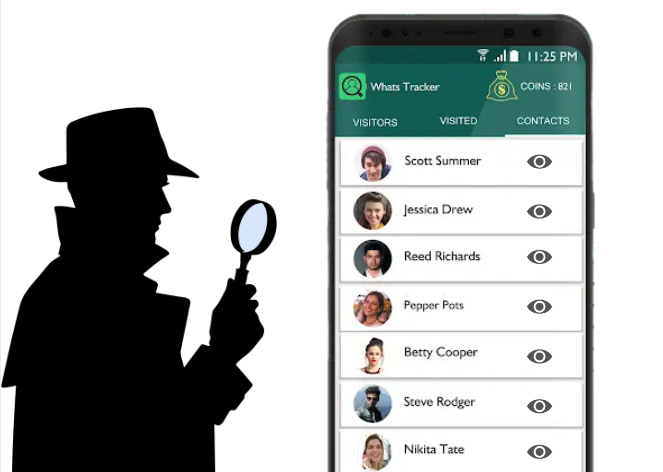
The names that appear on the screen aren't made up out of thin air — and that's what makes the illusion effective. The app requests access to your account, reads what's public (your follower list and recent interactions), and creates a ranking. Those who liked and commented the most in recent days rise to the top. Since these are usually the people who actually follow you, the result "makes sense.".
Three details undo the magic:
- Only people you already have some kind of relationship with will appear. A stranger who opened their profile never shows up on the list — and that's exactly who you wanted to know about.
- The list changes when the interaction changes., Not when someone visits.
- Installing the same type of application twice results in different lists. Each one uses its own ranking formula.
The real cost of installing one of these
In addition to not delivering on its promises, the category charges high prices in ways that aren't visible in the store:
- Credential. An app that asks for your username and password outside of the official network page is collecting login credentials. This can lead to spam being sent from your profile, access being resold, and account loss.
- Recurring subscription. A short trial with automatic renewal is the most common model, and the cancellation option is hidden. It's cancelled in your app store account, under subscriptions—not within the app itself.
- Full-screen ad with each tap, which is where the recipe for most free services lies.
- Disproportionate permissions. A metrics app doesn't need contacts, SMS, a microphone, or location.
Frequently Asked Questions
Is there any way to find out who accessed my profile?
Not on photo and video networks. The data is not recorded per profile in an accessible way, nor is it released through integration. The only network that officially offers this is LinkedIn.
What if the app has millions of downloads and a high rating?
Download volume doesn't validate the promise. A highly searched feature generates many downloads regardless of whether the feature exists, and the positive feedback usually comes from those who installed the feature before realizing it.
I can see who watched my Stories. Why can't I see who viewed my profile?
Because they are different things: in Stories, the platform decided to display the list, and everyone knows this when watching. Profile visits don't have this feature — and displaying it would change the behavior of those browsing.
I installed one of these apps. What do I do now?
Revoke their access in the social network's connected app settings, change the password, activate two-step verification, check active sessions and end any that you don't recognize, and cancel any subscriptions in your store account.
Is it possible to see how many people have viewed my profile, even without names?
On a professional account, yes: official metrics show profile visits as an aggregate number, along with reach and traffic source. It's real and useful information — it just doesn't come with identifying information.
Conclusion
The search for "who visited my profile" fuels an entire market built on data that doesn't exist. Among the available apps, the least bad ones simply reorganize information you already have; the worst ones steal your password. There isn't a single one that delivers on its promise.
Changing the question solves the problem. Activate your professional account, look at profile visits, reach, and audience engagement times, and use Story views when you want names. It's the information that exists, it's free, it's official—and it's still useful for something after the initial curiosity fades.
Read too
- Who Visited My Social Media Profile: What We Can Find Out
- Who Visited Your Social Media: Only LinkedIn Shows
- Did Someone Hack Your Social Media? How to Really Check
- Past Life App: Entertainment, Not Fortune Telling
- Free Shipping Coupon: The Rules That Actually Enable Delivery
- More battery on your cell phone: how to find out what's draining your power.