Herd Management via Mobile Phone: How to Choose the Right App
 Put Rodrigo Oliveira
Managing livestock via mobile phone is no longer a novelty. Today the problem is different: choosing between dozens of similar apps, many abandoned, some with very few users. This text is a guide to choosing.
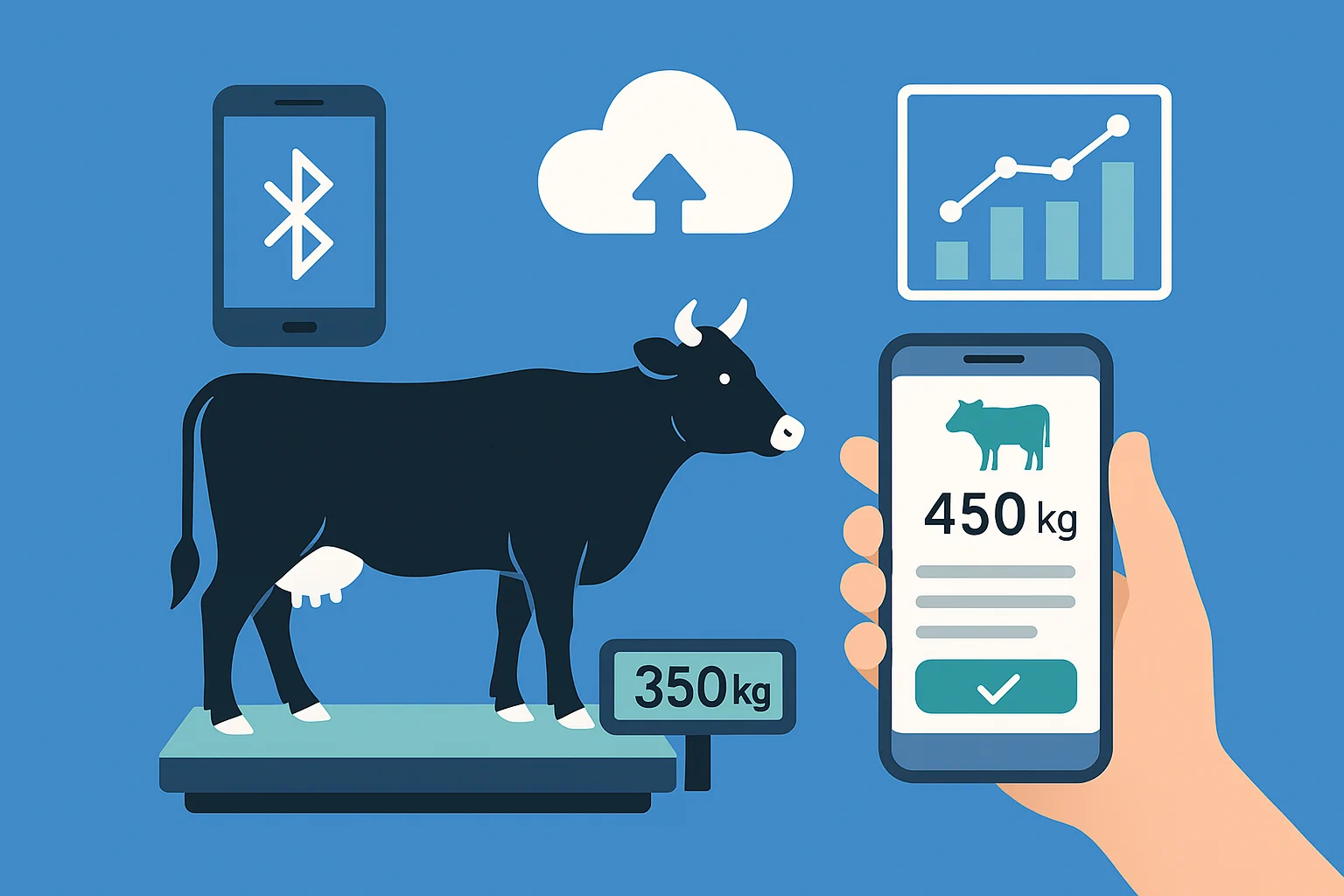
Before the criteria, a delimitation that avoids frustration. A herd management app. records and calculates. It doesn't weigh animals—smartphones don't have weight sensors—and it doesn't replace a veterinarian. What it does, and does well, is transform the daily routine of the animal pen into a comparable historical series.
What a good herd management app delivers
- Individual and batch registration, with ear tag, sex, date of birth, breed and category.
- Sanitary controlVaccinations, deworming, treatments, with schedules and alerts.
- Reproductive controlCoverage, pregnancy diagnosis, childbirth, interval between births.
- Weighings, entered manually or from scales, with calculation of average daily gain.
- Movement between fenced plots and lots, with a history of occupation.
- Reports Exportable as a spreadsheet or PDF.
The six criteria that really decide
1. Offline operation
It's not a differentiating factor, it's a requirement. Put your device in airplane mode and try registering an animal. If it freezes, the app wasn't designed for fieldwork.
2. Data Export
Look for the export function before migrating your registration. History locked inside an app is history at risk: apps frequently disappear from the store, and when that happens, the data that only existed there is lost along with the device.
3. Volume of reviews and date of last update
It's the fastest filter. Many apps in this category have fewer than a hundred reviews in the store, and some don't even have a published rating. This indicates a small user base and uncertain maintenance. An old last update usually means the app will break in the next Android version.
4. Multi-user
If more than one person will be rolling dice, check if the free plan allows it. This is usually the first feature to become paid—and it's precisely what makes the difference in team-based ownership.
5. Limit of the free plan
Many companies release up to a certain number of animals. Find out the limit before migrating the entire herd and getting stuck in the middle of the harvest season.
6. Permissions
A herd app needs storage, a camera, and maybe location services. It doesn't need contacts, SMS, or a microphone. If they ask for it, refuse.
What no herd app does
- Weigh the animal. The cell phone does not have a mass sensor. What exists is an estimate based on tape measurements — barimetry — with a range of 5% to 10%, or the record of a weighing done on a scale.
- Replace the scale in sales, official weighing, and medication dosage. Dewormer, antibiotic, and acaricide are dosed per kilogram: underdosing selects for resistant parasites in the entire herd; overdosing causes intoxication and lengthens the withdrawal period before slaughter.
- Diagnose. He records the symptom and treatment; the course of action is up to the veterinarian.
- Issuing an official document on your own. Animal transit permits and other documents follow the rules of the state agricultural defense agency. Some apps can help with filling them out, but issuance depends on the official system.
Real options in the store
There are herd systems with weight modules, such as... My Cattle Manager and the Easy Herd, in addition to national tools such as Bov Management It is JetBov Pasture, more focused on area management and scores. For dairy herds, there is the IDEAGRI APP. And there are also free apps from public institutions, such as... Right Pasture and the $upplementa Certo, from Embrapa, which tackle the other half of the problem: pasture and supplementation that generate weight gain.
Compare the rating, number of reviews, and update date of each before deciding. And test with a small batch before migrating the entire property.
How to deploy without abandoning it halfway through.
- Start with just one module, usually the restroom or the weighing station.
- Define who rolls the die and when.
- Register outside of the property's peak work hours.
- Standardize the way you measure and record data so that comparisons make sense.
- Export the backup after each harvest and save it outside of your mobile phone.
What if the app goes offline?
This happens frequently in this category, and the problem isn't the app itself: it's the history. An app removed from the store continues to function on the device where it's already installed, but it stops receiving updates and cannot be reinstalled on a new phone. If the herd's registration only exists there, it disappears along with the broken or replaced device. An exported spreadsheet saved in email or a cloud service solves the entire problem and costs nothing.
The four records that underpin any herd system.
Before comparing applications, it's important to understand that the information already exists on the property—scattered in notebooks, invoices, receipts, and the memories of those who work there. The software doesn't create this data; it organizes it. And that's why implementation succeeds or fails before any comparison of features.
- Individual and immutable identification — earring, number, and the discipline of always using the same code. Changing the numbering system mid-way breaks the pattern.
- Events with a date — birth, weaning, entry and exit from pasture, breeding, diagnosis, treatment, sale, death.
- Inventory movement — feed, mineral salt, medicine, fuel.
- Cost by date and category Without that, there is no cost per arroba or per liter, which is the number that indicates whether the year ended in the black.
A system fed with these four elements delivers a useful report. If fed only partially, it delivers a pretty graph but the wrong conclusion—which is worse than having no report at all.
This only appears when the record exists.
- Cost per unit produced, the indicator that almost no one has without registration.
- Performance by plot and by pasture., which reveals which area is supporting the herd and which is lagging behind.
- Calving interval and pregnancy rate, which depend entirely on the recorded date.
- An animal that doesn't pay for itself. — dam with a history of reproductive failure, animal with consistently below-average weight gain.
- Traceability, which has ceased to be a differentiating factor and has become a requirement for buyers and quality programs.
- Document for credit. Banks and cooperatives request credit history; property with registration receives better terms than property with an estimated head count.
Implement without abandoning in the second week.
The number one reason for quitting isn't price or resources: it's that the routine doesn't fit into the workday. What works:
- Start with just one module. Herd registration and weighing. Reproduction, inventory, and financial management come later, once the first step has become routine.
- Register the herd in stages., Do it in batches, and don't try to digitize ten years' worth of notebooks at once.
- Launch at the time of the event., ...by whoever is on the operation. A record passed from memory at the end of the day loses the date and detail.
- Individual access for each person., Instead of a shared password — this way you can see who posted what and revoke who leaves.
- Set a fixed day for the conference., Weekly, to review what has been released.
- Keep the paperwork running in parallel for the first month. It's the safety net while trust in the tool is established.
And the precaution that prevents losing everything: export by harvest or by year And save the file outside the system. Years of records are worth more than any monthly fee — and it's precisely this collection that gets stuck when exporting isn't possible. Testing the output before entering is the most valuable piece of advice when making this choice.
Frequently Asked Questions
Is it worth starting with a free app?
It's worthwhile, and it's the recommended approach. The free version reveals whether the registration routine will actually work in practice—which is the hard part. If the releases are up-to-date within two months, the investment in the paid version is justified.
Do I need to register the entire herd at once?
No, and trying that is what makes many people give up. Start with a batch, or the parent stock, and expand from there. The old history comes later, if it's included at all.
What if I don't have a signal in the corral?
Then offline functionality stops being a convenience and becomes a requirement. Test it in airplane mode before choosing: if it doesn't record, the app isn't right for you.
Who should make the releases?
Whoever is on duty at the time of the event. Each person has their own access — a shared password prevents knowing who posted what and remains valid for those who have already left.
Does the app replace the technician or the accountant?
No. He organizes the data that both need, which significantly shortens the work for both. The technical decision and the fiscal obligation remain with whoever has professional responsibility.
Conclusion
The best livestock management app is the one you can feed every day. Offline functionality, data export, active maintenance, and honest permissions—these four criteria eliminate most of the bad options in the store.
And keep in mind the tool's limitations: it organizes and calculates, but the scale is what weighs and the veterinarian is what diagnoses.
Read too
- Animal Scale on Your Cell Phone: How to Record the Weight of Your Pet and Herd
- How to Weigh Your Cat at Home: The Right Method and the Role of the App
- Mobile Scale App: Why It Weighs Nothing
- Poultry Scale: How to Control Batch Weight Using Your Cell Phone
- Digital Tape Measure on Your Cell Phone: How to Measure Better and Where It Falls Short.
- Weighing Animals by Cell Phone: What the App Records and What It Estimates